
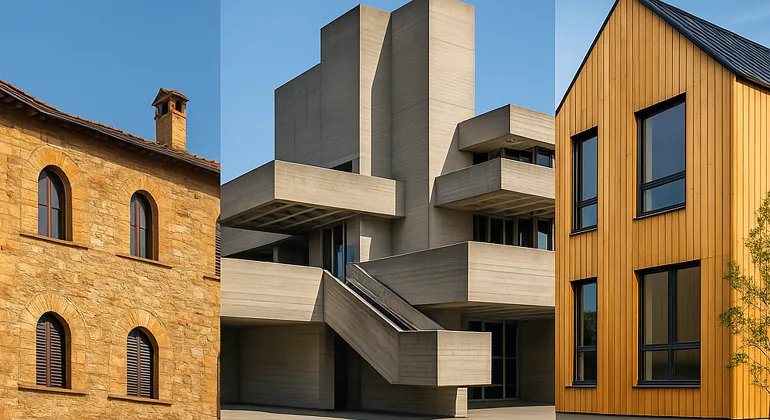
The New European Wave: How Italy, the UK, and the Nordics Are Redefining Sustainable Architecture
I. Introduction — Europe’s Architectural Reset
Across Europe, architecture is undergoing one of the most transformative shifts since the post-war reconstruction boom. The urgency of climate change, soaring energy costs, and evolving EU-wide sustainability frameworks have forced architects, developers, and policymakers to rethink the built environment from the ground up.
Italy, the United Kingdom, and the Nordic countries now stand at the forefront of this shift.
Their approaches differ—Italy draws on deep craft traditions, the UK emphasizes performance-driven innovation, and the Nordics champion holistic, human-centric environmental design.
Yet all three share a common vision: architecture must move beyond aesthetics and deliver measurable, long-term ecological value.
This “New European Wave” offers valuable lessons not only for the Western world but also for countries like South Korea, where urban density, redevelopment cycles, and rising sustainability demands require fresh architectural thinking.
II. The European Design Vanguard: Italy, the UK, and the Nordics
1. Italy — Craftsmanship Reinvented Through Sustainability
Italy’s architectural identity has long been rooted in materiality, craft, and contextual sensitivity.
What’s changing is how these principles are being mobilized for sustainability.
Contemporary Italian practices increasingly emphasize:
Reuse of traditional materials such as natural stone, terracotta, and lime-plaster
Adaptive reuse of historical buildings
Climate-responsive façades that reinterpret vernacular shading systems
Highly efficient district-energy retrofits for medieval urban cores
Cities like Milan, Turin, and Bologna are becoming testbeds for regenerative design, where old structures are not demolished but reprogrammed for modern use.
Italy demonstrates that sustainability is not only technological—it is often cultural.
2. United Kingdom — Performance-Driven and Innovation-Focused
The UK is taking a more technical route. With some of Europe’s strictest carbon-performance regulations, British architects now treat operational and embodied carbon as fundamental design parameters.
Key UK-driven trends include:
Whole-life carbon accounting
Circular construction materials
High-performance envelopes for UK climate zones
Mass timber adoption even in dense urban contexts
Large-scale retrofits like the London office-to-residential conversions
British studios and engineering firms are also early adopters of digital simulation tools—thermal modeling, lifecycle assessment (LCA), and material circularity algorithms.
The UK emphasizes a future where architecture is quantifiable, verifiable, and transparently low-carbon.
3. Nordic Countries — Human-Centered Environmentalism
The Nordic region (Denmark, Sweden, Norway, Finland, Iceland) has become synonymous with sustainable architecture—and for good reason.
Their design values center on:
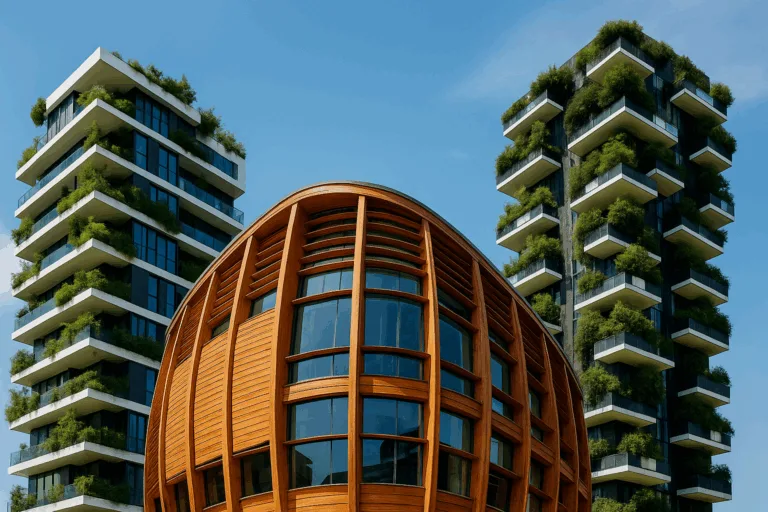
Large-scale mass-timber innovation
Passive house principles
Natural ventilation and daylight maximization
Community-centric urban planning
Seamless integration of nature and public space
Nordic cities redefine what “green” means—not cosmetic green walls, but deep ecological intelligence baked into every decision, from soil health to transit planning to thermal comfort.
Their ethos: If a building does not improve human wellbeing, it cannot be considered sustainable.
III. How Energy, Materials, and Zero-Carbon Strategies Are Evolving
1. Energy Reduction as the New Currency
Europe’s energy crisis accelerated the shift toward:
Super-insulated façades
High thermal-mass materials
Decentralized renewable energy microgrids
Smart building management systems (BMS)
Energy performance is now a core economic consideration, not an optional upgrade.
2. Circular and Low-Embodied Carbon Materials
The European market is rapidly adopting:
Recycled steel and aluminum
Bio-based insulation
Engineered timber
Low-carbon concrete
Prefabricated building components
Material passports—digital IDs tracking environmental performance—are becoming standard.
3. Net-Zero and Regenerative Strategies
Leading firms now target:
Net-zero operational emissions
Net-zero embodied carbon
Regenerative landscaping
On-site water harvesting and reuse
Biodiversity uplift metrics
Net-zero is no longer visionary; it is becoming regulatory.
IV. EU Taxonomy: The Policy Engine Transforming the Built Environment
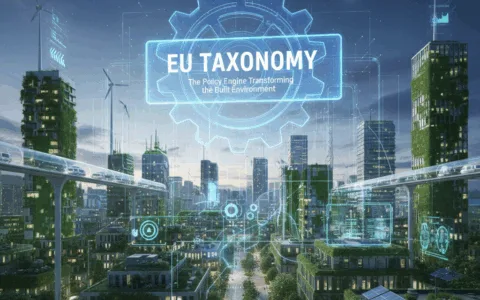
The EU Taxonomy—a classification system guiding sustainable finance—has fundamentally changed architecture.
It influences:
What gets funded
How construction is measured
Which design strategies become industry norms
Buildings must now meet verifiable sustainability thresholds to qualify for financing.
This has accelerated:
Green-certified developments
Retrofitting of older building stock
Transparent carbon reporting
Adoption of LCA frameworks
EU Taxonomy effectively rewrote the rulebook:
If a building cannot prove sustainability, it will struggle to attract capital.
V. What Korea Can Learn—and Apply Today
South Korea’s intense development cycles, redevelopment models, and urban density make European lessons especially valuable.
1. Embrace Adaptive Reuse Over Demolition
Italy shows how old buildings can gain new economic value without erasing heritage.
2. Prioritize Performance, Not Cosmetic Sustainability
UK-style whole-life carbon assessments can redefine Korean building standards.
3. Adopt Nordic Human-Centered Master Planning
More natural light, community spaces, and human-scaled streets improve quality of life.
4. Build a Carbon-Finance Link
EU Taxonomy’s logic—funding tied to performance—can be applied to Korean real estate investment.
5. Expand Innovation in Materials
Mass timber mid-rise, low-carbon concrete, and bio-based insulation are immediate opportunities.
VI. Conclusion — A New Architectural Era
The rise of Italy, the UK, and the Nordics in sustainable architecture marks a turning point for the global built environment.
Architecture is no longer judged solely by form or cultural expression but by its ecological performance, resilience, and human impact.
This new European wave offers something profound:
A blueprint for how nations—including Korea—can design cities that are not only energy-efficient but emotionally resonant, socially inclusive, and environmentally regenerative.
The future of architecture will not be defined by height or scale,
but by how thoughtfully it responds to the planet and the people who inhabit it.
*Link: https://www.sjglobal.site/lp53

