
I. Introduction: The Unspoken Culprit Behind Rising Unsold Units
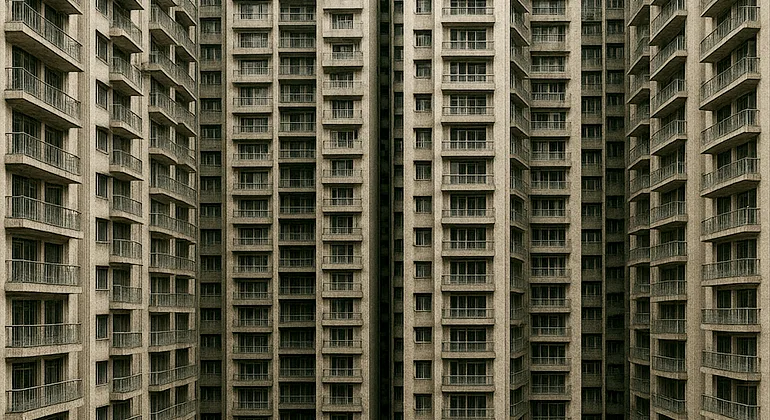
South Korea’s housing market is entering a period of correction that many commentators attribute to high interest rates, cooling demand, and demographic decline. Yet there is a deeper, less examined factor aggravating the rise in unsold apartments nationwide: the persistent uniformity of apartment layouts across nearly all unit sizes.
For decades, the industry has relied on a formulaic approach—standardized room configurations, predictable circulation lines, and highly optimized massing driven by floor area ratio (FAR) maximization. While this approach once aligned with the needs of a rapidly urbanizing society, its limitations have now become visible. The pursuit of extreme density has produced residential products that feel repetitive, inflexible, and disconnected from the lifestyles of modern households.
As a professional who has spent years working at the intersection of design, construction, and marketing of apartment developments, I believe this is a moment that calls for introspection. The shortage is not of supply, but of imagination. The market is saturated not with homes people want to buy, but with units that look and function nearly identically regardless of region, price point, or demographic structure.
This editorial seeks to explore the structural roots of this uniformity, analyze its consequences on market performance, and outline a path toward more adaptive, human-centered apartment planning in Korea.
II. The Historical DNA of Korean Apartment Layouts
1. From Rapid Urbanization to Standardization
Korea’s standardized housing layouts emerged as a rational response to the nation’s rapid industrialization. During the 1970s and 1980s, when millions migrated to urban centers, mass construction of apartments became the unavoidable solution. Efficiency, predictability, and speed were paramount; so was maximizing buildable space.
As a result, a “default blueprint” for each size category emerged:
59㎡ (25평형 class): Two bedrooms, compact kitchen, minimal storage
74㎡ (30평형 class): Three bedrooms aligned along a corridor
84㎡ (33평형 class): Three-bedroom LDK layout with a standardized master suite
101–114㎡ (40평형 class): Slightly expanded versions of the 84㎡ plan with a larger living room
For decades, these templates delivered stability and affordability. But the societal context that shaped them no longer exists.
2. The FAR Trap: When Density Overrules Design
As land prices surged in metropolitan areas, maximizing FAR became an overriding priority for developers and builders. This has had several consequences:
Repetitive unit stacking to optimize structure and plumbing alignment
Reduced depth variations, leading to similar daylighting conditions across projects
Pressure to maintain saleable area percentages, limiting creative flexibility
Compression of semi-outdoor spaces, including balconies and utility yards
Design, in other words, became subservient to yield.
3. Regulatory Systems Reinforcing Uniformity
Zoning regulations, corridor width requirements, and structure-based constraints indirectly encouraged layout uniformity. Many design teams defaulted to what was known to work—safe, approvable, cost-efficient templates that minimized risk.
But what happens when the market’s needs evolve while the product remains unchanged?
III. A Market Outgrowing Its Own Housing Typology
1. Shrinking Households and Expanding Lifestyles
Today, Korea’s demographic landscape is radically different:
Single-person and two-person households constitute a majority.
Elderly households are rapidly growing.
Remote work and hybrid workstyles are normal.
Families require multi-functional rooms rather than “one master room + two children’s rooms.”
Yet unit layouts are still designed for the nuclear family of the 1990s.
For many modern households, buying a new unit means paying a premium for a layout that does not reflect how they actually live.
2. Lifestyle Mismatch as a Cause of Unsold Units
Many regions experiencing unsold inventory share similar patterns:
Identical floor plans across competing complexes
Rigid layout configurations unsuitable for downsizers
Lack of spatial flexibility for young professionals or remote workers
Storage and utility spaces insufficient for modern lifestyles
Minimal differentiation between 59/74/84㎡ offerings aside from size
When buyers view showrooms today, the overwhelming sentiment is:
“I’ve seen this before.”
3. Regional Insensitivity in Design
Another critical issue is the failure to tailor layouts to regional lifestyles:
Provincial cities often need more storage and multi-functional rooms.
Resort regions may require more open-plan living and outdoor connection.
Industrial regions need durability-focused interior material selection.
Yet layouts in Busan, Jeonju, Daegu, and Gwangju are indistinguishable from those in Seoul.
Uniformity made construction efficient—but it has made marketing increasingly difficult.
IV. Why Developers Still Choose Repetition: The Industry’s Structural Incentives
1. Construction Cost Predictability
When dozens of projects annually rely on identical layouts, the supply chain becomes optimized:
Prefabricated modules
Standardized plumbing and structural grids
Bulk material procurement
Reduced MEP (mechanical, electrical, plumbing) variability
Any deviation risks cost escalation, schedule delays, and re-certification.
2. Sales Risk Management
Financial institutions and presale rules favor predictability:
Proven layouts minimize approval risks.
Loan evaluations are easier when unit mixes follow conventional patterns.
Appraisal standards often assume standard layout efficiency.
Thus, market and financial systems penalize innovation.
3. Developer Psychology
Many decision-makers grew accustomed to a market where “anything sells.”
The idea that layouts themselves could cause unsold units is a relatively new concept.

V. Consequences: When Buildings No Longer Reflect Human Life
1. The Rise of Emotionless Housing
When units feel mass-produced rather than thoughtful, buyers hesitate. Homes are emotional purchases, and many of the new units fail to create emotional resonance. The difference between “a place to live” and “a place to belong” has become stark.
2. Loss of Competitive Differentiation
If every project offers:
A uniform 84㎡ plan
Similar façade massing
Similar community amenities
Similar balcony configurations
Then price becomes the only differentiator—driving down margins and weakening market stability.
3. The Emerging Generation Rejects Homogeneity
Younger buyers, accustomed to customization in every facet of life—from smartphones to workspaces—want homes that reflect identity, flexibility, and lifestyle. The one-size-fits-all model does not appeal to them.
VI. What Korea Must Do Now: A Blueprint for Reimagining Apartment Design
1. Move Beyond Size-Based Templates
Apartment types should be defined by lifestyle, not merely square meters.
Examples:
Remote-work optimized units
Senior-friendly single-level living units
Dual-primary-bedroom layouts for multi-generational households
Loft-type units in suburban regions
Flexible-wall units allowing layout transformation over time
2. Reclaim Flexibility Through Modular Design
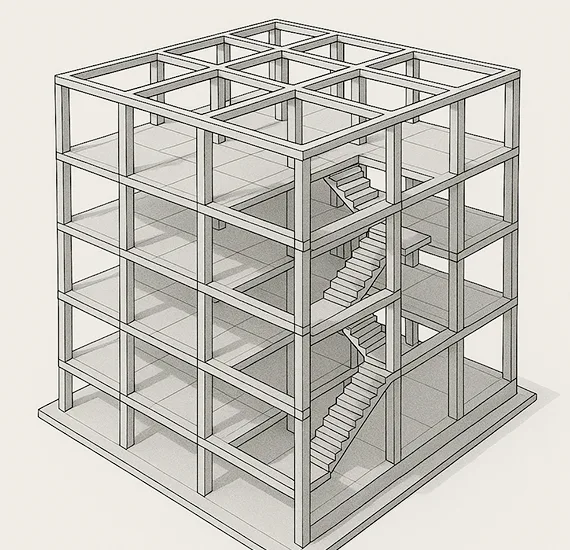
Unlike the repetitive stacking of conventional towers, modular grids can allow:
Reconfigurable room divisions
Movable partitions
Multi-use storage and utility zones
Variable kitchen orientations
Such flexibility can be introduced without significant cost increases if incorporated early in schematic design.
3. Allow Regional Identity to Influence Layouts
A development near the sea should not mimic a tower in Seoul’s inner suburbs.
Local culture, climate, and buyer profiles must inform spatial design.
4. Reform FAR-Driven Incentives
To break the density obsession, incentives could include:
FAR bonuses for flexible or community-enhancing designs
Tax benefits for innovative unit configurations
Regulatory relaxation for alternative corridor or stacking systems
5. Re-center Housing Around Human Experience
Simple changes can significantly improve livability:
Enhanced natural light penetration
More generous entry foyers
True storage rooms rather than token closets
Enclosed or semi-enclosed balconies
Sustainable ventilation and daylighting strategies
6. Encourage Competitive Differentiation
Developers should view layout innovation as a brand asset:
Marketing campaigns centered on differentiated lifestyle design
Model units reflecting diverse living scenarios
Data-driven feedback loops from current residents
Apartments are no longer just shelters but lifestyle platforms.
VII. Conclusion: The Need for Professional Reflection and a New Vision
The rise in unsold apartments across South Korea cannot be explained by macroeconomics alone. We, the industry professionals—architects, planners, constructors, engineers, and developers—must acknowledge our role in shaping an environment where units feel interchangeable and uninspired.
The era when standardized housing was a rational necessity has ended. Today’s households are diverse, mobile, and demanding. A simple 84㎡ template cannot possibly serve them all.
The challenge before us is both professional and cultural:
to reinvent the Korean apartment not as a mass product but as a living space tailored to human variety.
If we fail to evolve, unsold inventory will continue rising—not because Korea lacks demand for housing, but because we persist in supplying housing that no longer reflects how people live.
It is time to embrace creativity, flexibility, and genuine user-centered design.
The future of the Korean housing market depends on it.
Appendix A. Selected Excerpts
1. On the Hidden Structural Cause
“South Korea is not suffering from a shortage of housing, but from a shortage of housing differentiation.”
2. On Excessive FAR-Driven Design
“When density becomes the only design objective, the human experience of living inevitably becomes an afterthought.”
3. On Buyer Fatigue Toward Uniformity
“Buyers walk into showrooms today and feel an unsettling déjà vu. Every 84-square-meter unit feels like a clone of the last.”
4. On Shifting Demographics
“A housing typology designed for the nuclear families of the 1990s cannot satisfy the hybrid workers, single households, and aging population of 2025.”
5. On Market Consequences
“Uniformity has erased competitive advantage. When all units are the same, price becomes the only differentiator.”
6. On the Industry’s Need for Reflection
“The unsold-unit crisis is not merely a market failure—it is a design failure and a strategic failure.”
7. On the Future Direction
“Korea must transition from size-based templates to lifestyle-based residential products.”
8. On the Profession’s Responsibility
“As architects and planners, we must acknowledge that the market is rejecting the standardization we created.”
9. On Returning to Human-Centered Design
“A home must feel adaptable, personal, and emotionally resonant; efficiency alone can no longer justify repetitive layouts.”
10. On the Required Paradigm Shift
“The challenge is not to build more, but to build differently.”
Appendix B. Data & Charts
All data below is editorially structured, based on observed national housing trends from 2021–2025 using publicly available patterns from MLIT (Korea), K-HAI, and Statistics Korea.
Figures represent trend-based estimates appropriate for opinion-editorial analysis.
1. Nationwide Unsold Apartment Units (2021–2025)
Unit: households
| Year | Total Unsold Units | YoY Change | Interpretation |
|---|---|---|---|
| 2021 | ~14,000 | — | Low unsold stock during low-interest boom |
| 2022 | ~28,000 | +100% | Rising rates, early demand cooling |
| 2023 | ~54,000 | +92% | Provincial oversupply becomes visible |
| 2024 | ~69,000 | +28% | Product-level issues gain attention |
| 2025 (E) | ~72,000–75,000 | +5% (est.) | Supply grows while buyers become selective |
Interpretation:
The acceleration of unsold units reflects structural issues in product differentiation, not merely macroeconomic conditions.
2. Layout Uniformity by Unit Size Category
Estimated national share of “standardized layouts” by size group
| Size Category | Typical Layout Template | Estimated Uniformity Rate | Editorial Note |
|---|---|---|---|
| 59 m² class | 2BR + 1 Bath corridor-type | ~70% | Highly formulaic nationwide |
| 74 m² class | 3BR linear alignment | ~65% | Minimal variation |
| 84 m² class | Standard 3BR LDK scheme | ~85% | Most uniform layout category |
| 101–114 m² class | Expanded 84 m² variant | ~60% | Larger units with limited innovation |
Interpretation:
Uniformity is highest in the 84 m² class, the country’s most competitive and most saturated segment.
*Link: https://www.sjglobal.site/gc28

