
The Rising Tide of SMRs: A Global Shift in Nuclear Energy
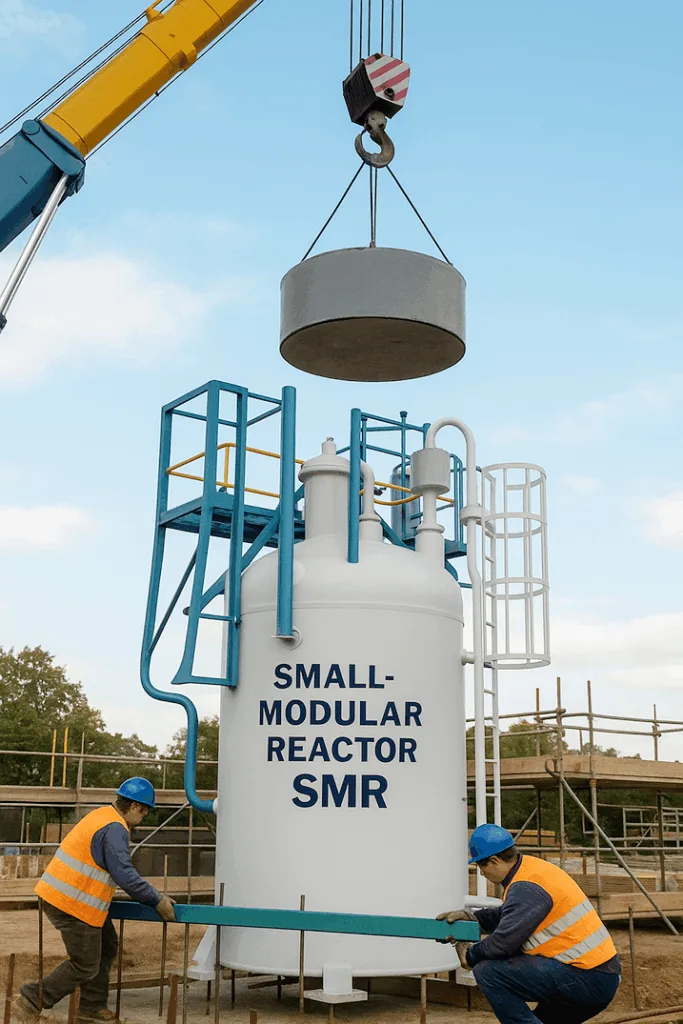
In recent years, the landscape of nuclear power is quietly shifting. The concept of the small modular reactor (SMR) – a nuclear reactor whose electrical output is much smaller than traditional large-plants, often factory-built and shipped to site – is gaining serious traction. IAEA+2World Nuclear Association+2
According to the Nuclear Energy Agency (NEA), some 51 SMR designs are in pre-licensing or licensing in 15 countries, and roughly 85 active discussions are underway between developers and potential hosts. Nuclear Energy Agency (NEA)+1
The appeal is clear: SMRs promise lower up-front capital risk, more flexible siting, and in many designs enhanced safety through passive systems. IAEA+1
At the same time, global drivers – including rising electricity demand (especially for data centres and industrial heat), the push for decarbonisation, and energy security concerns – are aligning in favour of SMR deployment. Nuclear Energy Agency (NEA)+1
However, scale-economics remain a key challenge. While the cost per kilowatt of a full-scale large nuclear plant benefits from mass, the SMR approach must offset that by serial manufacture, modularisation and reduced construction time. ITIF+1
In short: SMRs are no longer just a theoretical “nuclear future” – they are becoming part of present-day energy strategies around the world.
Cooling Modes: Air (Dry) vs Water (Wet / Conventional) – What’s at Stake
In the context of SMRs, the choice of cooling technology is an important design and siting consideration. Broadly speaking:
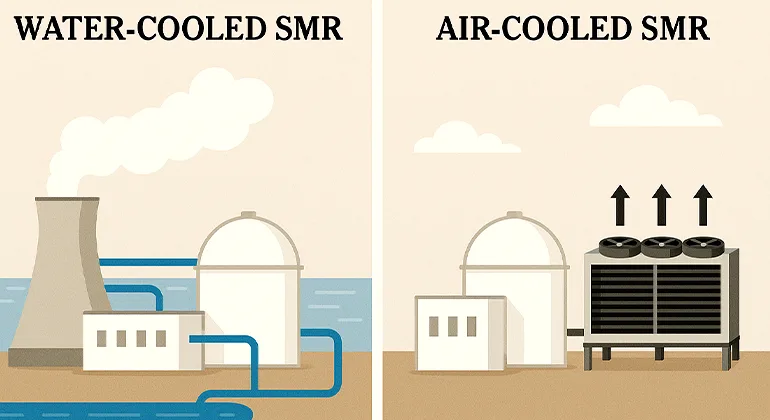
A water-cooled SMR uses water (either in the reactor coolant loop, or ultimately for heat rejection via cooling towers or ponds) as the main heat transfer medium. Many current SMR designs are derivatives of light-water reactor technology. World Nuclear Association+1
An air-cooled or “dry-cooling” approach rejects the reactor’s waste heat to ambient air (or through finned heat exchangers) rather than relying on large volumes of water. While this term is less commonly applied in SMR literature, the analogous concept is a cooling system that minimises dependence on external water.
Each mode carries trade-offs:Water-cooled systems are technically mature, widely understood, and often more thermally efficient, but they demand reliable large-volume water supply, cooling-water infrastructure, and in some sites may face regulatory or environmental hurdles (thermal discharge, water scarcity). uat-cm.advisian.com
Air or dry-cooling approaches reduce dependency on water and thus may enable siting in more arid or remote locations—but typically at some thermal performance penalty (i.e., lower heat rejection efficiency in high ambient-temperature conditions) and potentially higher cost.
In sum: the cooling mode must align with site climate, water availability, regulatory regime and grid scale. For SMRs deployed worldwide, the cooling decision is a key piece of the nuclear infrastructure puzzle.
Recommendation by Country: Best Fit Cooling Strategy for SMRs
Below are tailored recommendations for the United States, South Korea, Japan, France and Saudi Arabia, taking into account their geography, water resources, regulatory environment and energy strategy.
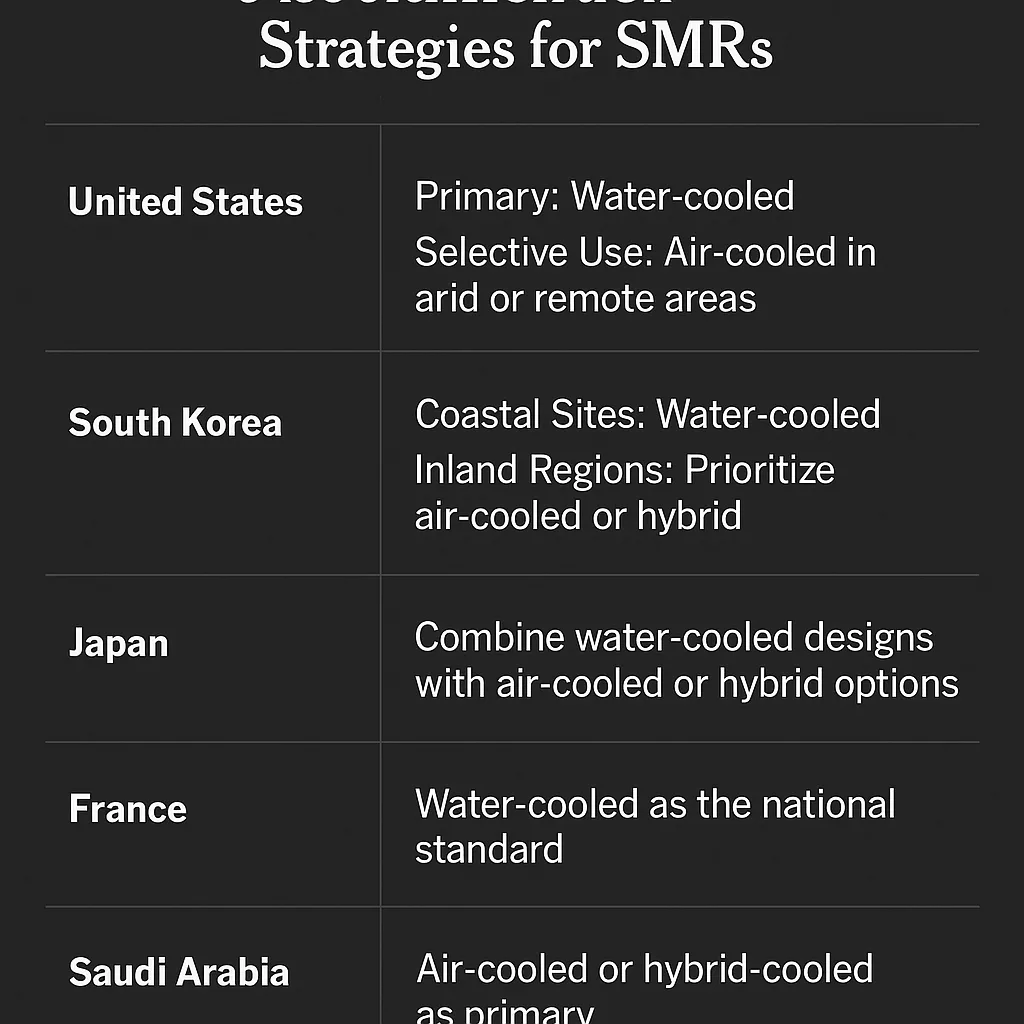
United States
The United States’ large geography allows for a wide range of SMR deployment scenarios, from water-rich regions in the Northeast to water-stressed basins in the Southwest. With deep experience in light-water reactor technology and a regulatory system optimized for water-cooled designs, the default engineering pathway remains conventional.
Recommendation:
Primary: Water-cooled SMRs for most regions.
Selective Use: Air-cooled SMRs in arid states (Arizona, Nevada, New Mexico) or remote microgrid applications.
South Korea
South Korea’s nuclear infrastructure is overwhelmingly coastal, where water access and cooling discharge pathways are well established. Coastal regions remain ideal for water-cooled SMRs, given Korea’s regulatory familiarity and high thermodynamic efficiency.
The situation inland is fundamentally different. River systems have limited thermal-discharge capacity, environmental regulations are tighter, and communities are more sensitive to water-intensive industrial projects. Moreover, many inland industrial clusters and planned energy-intensive developments—such as data-center corridors—seek non-coastal siting flexibility.
Recommendation:
Coastal Sites: Water-cooled SMRs remain optimal.
Inland Regions: Prioritize air-cooled or hybrid-cooling SMRs to reduce freshwater dependency, avoid thermal-discharge limits, and increase public-acceptance feasibility.
Japan
Japan’s island geography and high population density make siting exceptionally complex. While water-cooled SMRs match Japan’s historical operating experience, many candidate sites—especially in earthquake-sensitive or ecologically fragile coastal zones—face strong constraints.
Dry-cooling or hybrid-cooling designs offer a strategic advantage: they reduce reliance on marine discharge and expand the feasibility of non-coastal or elevated inland sites.
Recommendation:
Combine water-cooled designs with air-cooled or hybrid options to expand siting flexibility and minimize marine-environmental impacts.
France
France’s nuclear identity is deeply rooted in its water-cooled fleet. Abundant river systems, a mature supply chain, and entrenched public-sector expertise all point toward continuity rather than divergence. While climate-driven river-temperature variations have occasionally limited output, France still retains strong water-cooling fundamentals.
Recommendation:
Water-cooled SMRs as the national standard.
Air-cooled systems only for special remote locations or micro-grid industrial applications.
Saudi Arabia
Saudi Arabia represents the clearest case for dry-cooling adoption. With severe freshwater scarcity, extreme temperatures, and vast remote territories suitable for industrial development, water-cooled SMRs would impose high desalination costs and increased corrosion risk.
Dry-cooled or hybrid-cooled advanced reactors align naturally with desert siting, and they decouple SMR deployment from precious freshwater resources.
Recommendation:
Air-cooled or hybrid-cooled SMRs as the primary pathway.
Consider water-cooled designs only if using seawater infrastructure near coastal industrial hubs.
Conclusion
Cooling strategy is not merely an engineering decision—it is a national-scale energy-planning choice.
Water-cooled SMRs serve established nuclear nations with reliable water access and coastal siting.
Air-cooled SMRs unlock inland, arid, or remote deployments where water scarcity or regulatory pressure would otherwise hinder nuclear expansion.
As the global SMR market accelerates, countries that align their reactor design with geographic and environmental realities will move faster, face fewer regulatory obstacles, and ultimately achieve more resilient deployment.
*Link : https://www.sjglobal.site/hxbw

