
U.S. Sunbelt’s Construction Boom: Opportunities for Korean Developers
The American Sunbelt—stretching across Texas, Arizona, and Georgia—has entered a period of construction activity unmatched anywhere else in the United States. Tower cranes now rise above suburb edges, master-planned industrial districts expand into former farmland, and population inflows continue to reshape metropolitan boundaries. For Korean developers looking outward, the Sunbelt represents not only a booming real estate market but a structural shift in where America grows, invests, and builds.
1. Why the Sunbelt Is Outpacing the Rest of the U.S.
The Sunbelt’s rise is not a speculative bubble. It is the outcome of multiple long-term forces converging at once: migration, industrial strategy, federal subsidies, and business-friendly local governments.
Population and Workforce Migration
The Sunbelt has attracted more new residents than any other U.S. region for almost a decade. Lower housing costs, warmer climate, and abundant land have pulled workers and companies away from expensive coastal markets like California and New York. Texas alone gained more than 400,000 new residents in recent annual counts, reinforcing demand for residential, industrial, educational, and healthcare facilities.
New Industrial Geography
The CHIPS and Science Act and the Inflation Reduction Act have transformed states like Arizona and Georgia into strategic national manufacturing zones. Semiconductor fabs, electric-vehicle supply chains, battery plants, and logistics clusters now dominate site selection activity.
Where industry moves, development follows. Companies demand warehouses, worker housing, transportation links, and office or R&D facilities—often simultaneously.
Favorable Local Policies
Unlike coastal states—known for slow permitting and strict zoning—many Sunbelt cities built their growth on regulatory efficiency.
Texas offers some of the most flexible zoning practices in the country.
Arizona has created fast-track permitting for semiconductor and data-center projects.
Georgia provides county-level incentives that aggressively court industrial investment.
The result is a development landscape where projects move faster, construction costs remain relatively competitive, and risk-adjusted returns look more attractive to global capital.
For Korean developers used to complex domestic regulations, these conditions present both relief and challenge: speed is an advantage only for teams that understand the rules.
2. How Development Is Actually Structured in the Sunbelt
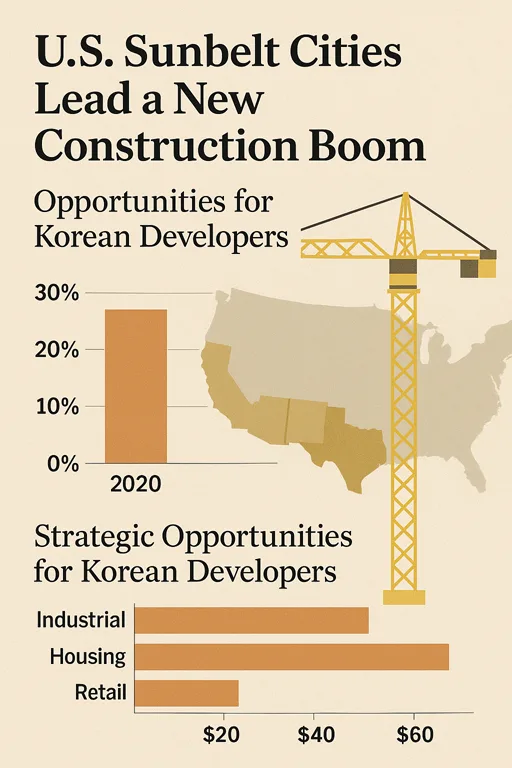
Entering the U.S. market requires more than land acquisition and a design team. The American development stack is a layered system—legal, financial, political, and operational. Korean developers often underestimate how different these structures are compared to those in Seoul or other Asian markets.
Entitlements: The Most Critical—and Misunderstood—Step
In the Sunbelt, permitting generally moves faster than in coastal regions, but it requires highly localized expertise. Each city, county, and utility authority may hold approval powers.
Pre-application meetings with planning departments determine feasibility early.
Traffic, water, and environmental impact reviews are often mandatory.
Negotiation with counties, rather than state agencies, is common for large projects.
A well-connected local land-use attorney can shave months off the timeline. An inexperienced one can lose years.
Capital Structures: Why Developers Rarely Invest Alone
The U.S. development model relies heavily on layered capital:
GP Equity (Developer stake): often 5–20%
LP Equity (Institutional investors): pension funds, private equity, sovereign funds
Construction Loans: banks, credit unions, insurance firms
For Korean developers, this means participating in large-scale projects without committing a majority of the capital. U.S. investors often prefer experienced foreign partners with strong design and construction oversight capabilities—precisely where Korean firms excel.
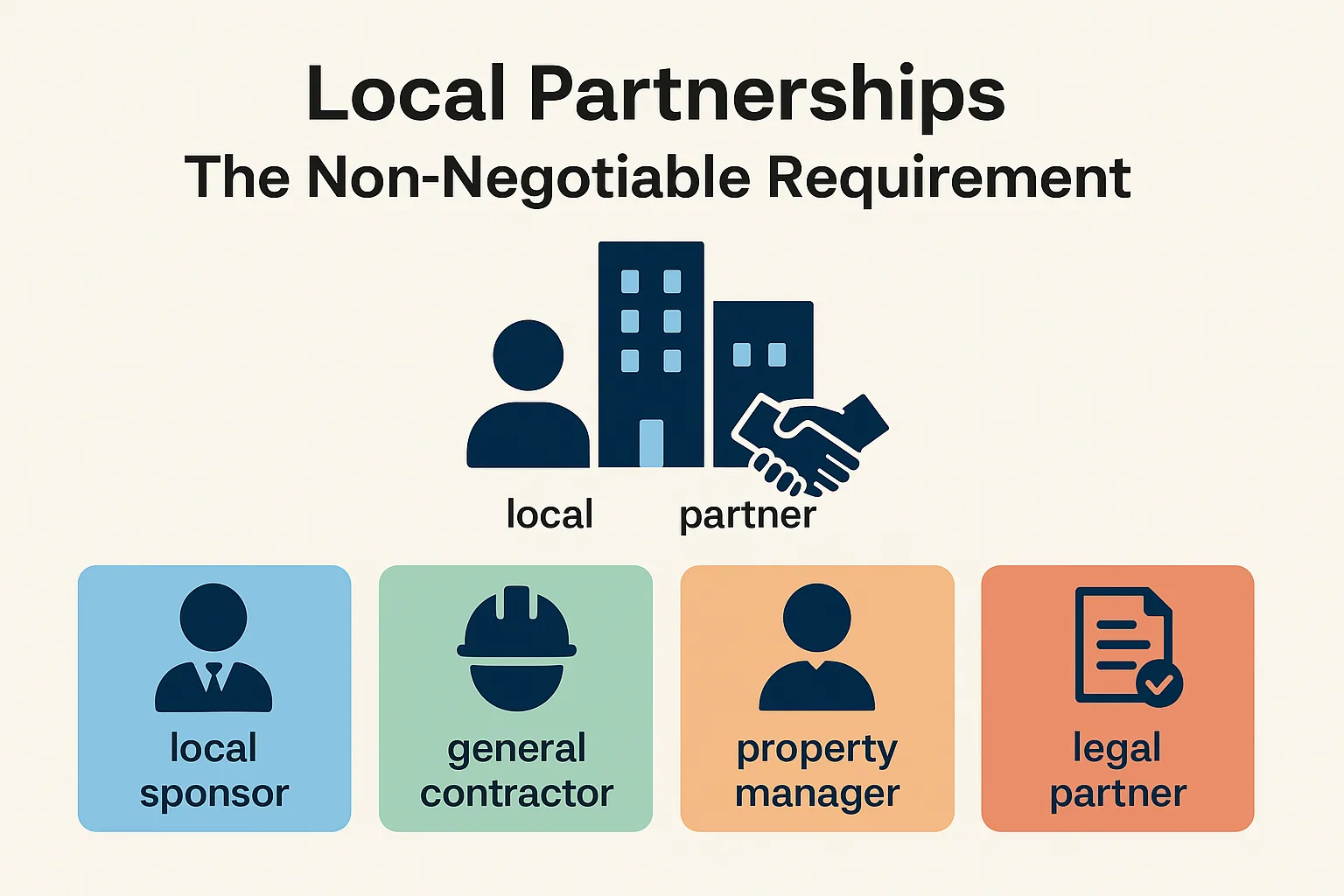
Local Partnerships: The Non-Negotiable Requirement
No foreign developer succeeds in the Sunbelt without a local operating partner. Successful projects typically include a coalition of:
A local sponsor with political and community relationships
A general contractor licensed and experienced in that state
A property manager who understands tenant trends
A legal partner who navigates zoning and county regulations
Rather than controlling everything directly, foreign developers benefit from forming joint ventures that blend local authority with global capital discipline.
3. What Success—and Failure—Looks Like in the Sunbelt
Success Case: Industrial District Near Dallas
A Korean-affiliated developer partnered with a Texas-based sponsor to build a 300-acre logistics cluster. Pre-leasing from national distributors secured bank financing ahead of construction. Flexible design packages, borrowed from Korean industrial park playbooks, reduced build time by 14%. The project achieved full stabilization one year earlier than projected.
Success Case: Data-Center Expansion in Phoenix
As semiconductor expansions accelerated, demand for redundant power and cooling surged. A consortium of U.S. and East Asian investors structured a multi-phase data-center development near major substation nodes. Korean contractors introduced efficiency-focused construction methods that lowered overall mechanical installation costs. The project attracted hyperscale tenants before completion.
Emerging Success: EV Supply Chain in Georgia
With Hyundai Motor Group expanding significantly in Georgia, the surrounding counties have become magnets for logistics and component suppliers. Developers who correctly anticipated the clustering effect are now delivering one of the fastest-growing industrial corridors in the country.
Risks That Have Already Hurt Projects
Not all stories are successful:
Infrastructure Gaps: Some counties lack water or substation capacity for large-scale projects.
Property Tax Volatility: Rising assessments have unexpectedly reduced yields on industrial assets.
Interest Rate Exposure: Developers relying on floating-rate construction loans suffered severe cost increases in 2023–2024.
Overestimation of Local Demand: Several residential projects underestimated out-migration elasticity and ended with slower lease-up speeds.
The lesson is clear: opportunities are strong, but only for teams with disciplined risk assessment.
4. Strategic Entry Playbook for Korean Developers

Large U.S. developers are already aggressive in Texas, Arizona, and Georgia. For Korean firms to enter effectively, strategic clarity is essential.
1. Enter Through Joint Ventures, Not Solo Projects
A 10–20% GP stake in a joint venture reduces risk while providing exposure to U.S.-grade returns. Local operators secure entitlements and community relations; Korean developers contribute design control, capital discipline, and construction management strength.
2. Choose Industry-Specific Development Niches
Rather than entering through generic residential or commercial projects, Korean firms should align with their industrial strengths:
Texas: mixed-use districts, industrial parks, build-to-rent housing
Arizona: semiconductor-related facilities, data centers, advanced industrial buildings
Georgia: EV supply chain logistics, manufacturing support infrastructure
These sectors offer the strongest demand visibility.
3. Prioritize Utility-Ready Land
The most underrated success factor in the Sunbelt is infrastructure readiness. Sites with confirmed water rights, substation access, and road connectivity reduce risk dramatically. Developers who secure these inputs early can negotiate better lease terms with tenants and investors.
4. Lead with ESG and Engineering Competence
Sunbelt climates demand high-efficiency systems—cooling, electrical resiliency, water optimization, heat management. Korean engineering firms possess advanced solutions in these areas, giving them a competitive edge. Aligning with U.S. ESG frameworks such as LEED or WELL strengthens institutional investor interest.
Conclusion: The Next American Growth Wave
The Sunbelt is not a temporary boom. It is the leading edge of a new American growth geography—one shaped by manufacturing reshoring, interstate migration, and aggressive state-level economic policy. As companies move south, so do the jobs, infrastructure, and investment flows that define long-term development value.
For Korean developers, the question is no longer whether the U.S. market is attractive. It is whether they choose to enter while the Sunbelt’s expansion curve is still in its early stage.
A decade from now, the region may look like a fully matured industrial corridor, dominated by established players. Entering today—strategically, cautiously, and through the right partnerships—offers the opportunity to participate before the landscape becomes crowded.
In short, the Sunbelt is becoming the most consequential real estate frontier in the United States. For Korean developers, it may be the most important global opportunity of the coming decade.

