
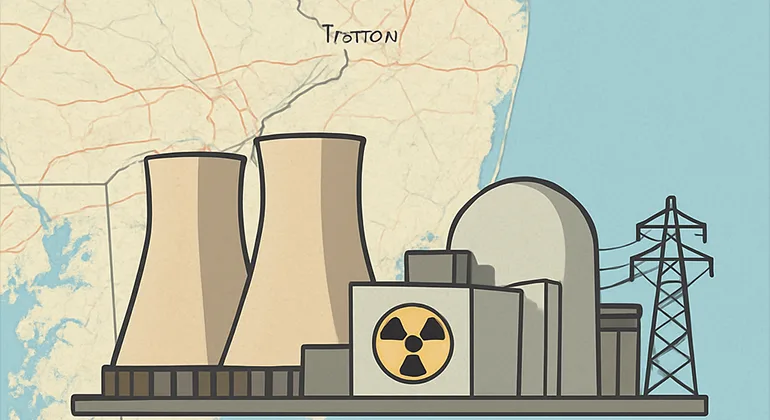
How Is It That New Jersey Still Has No SMR Under Construction?
There is a certain irony — almost theatrical in its clarity — in the fact that New Jersey, home to one of the world’s premier small modular reactor (SMR) manufacturing campuses, has yet to lay even the first ceremonial shovel of dirt for an SMR of its own.
Around the world, governments are rolling out nuclear blueprints with a sense of urgency not seen since the 1960s. From Ontario’s BWRX-300, already moving through excavation, to the United Kingdom’s Rolls-Royce SMR program, advancing with billions in public backing, the SMR era is no longer speculative. It is built into national budgets, stitched into industrial policy and embedded in climate strategy.
Yet in New Jersey — a state that often brands itself as a model of progressive energy planning — SMRs remain a topic of legislative hearings, white papers and press releases. Nothing more.
How is it possible that the state that can build SMRs, cannot seem to build one for itself?
A World That Has Moved From PowerPoint to Pouring Concrete
If the last decade was the age of nuclear PowerPoint decks, the mid-2020s mark the moment the world rediscovered concrete.
In Canada, bulldozers are already carving the foundations of North America’s first commercial SMR at Darlington. In the UK, ministers have selected Rolls-Royce as the preferred vendor and begun site designation for an initial fleet. Romania, China and Argentina are pushing ahead with the kind of first-of-a-kind projects that analysts in Washington once doubted would see daylight.
Each of these efforts recognizes a truth that architects and planners have long understood: energy systems are not abstractions; they are spatial realities. They occupy land, interact with communities, reshape infrastructure, and communicate—visually and politically—what a nation chooses to believe about its future.
Across the Atlantic and Pacific, governments are acting with the decisiveness of those who believe that a low-carbon future must be built brick by brick, not debated year by year.
But on America’s Eastern Seaboard, something is missing.
America’s Patchwork Progress — and the Curious Absence of New Jersey
The United States, to its credit, is not idle.
It is simply uneven.
In Wyoming, TerraPower’s sodium-cooled Natrium reactor has begun early site work.
In Tennessee, the TVA is moving the BWRX-300 through the NRC’s construction permit process.
In Michigan, Holtec — the very company manufacturing SMR components in New Jersey — is preparing to pair its SMR-300 with the restart of the Palisades plant.
In Texas, Dow and X-energy are designing a co-located reactor to power petrochemical operations.
These are not theoretical proposals. They are real projects with real land, real communities and real construction schedules. They demonstrate what happens when industrial strategy aligns with permitting, financing and civic vision.
Meanwhile, New Jersey — home to the Krishna P. Singh Technology Campus in Camden, a facility specifically built to mass-produce SMR components — remains on the sidelines. Legislators have drafted frameworks for SMR governance, and Holtec has “evaluated” Oyster Creek for potential deployment. But evaluation is not excavation.
The state that builds reactors is not building one.
Why New Jersey Remains Frozen
1. Economics Without a Sponsor
SMRs are often marketed as the “iPhone of nuclear energy”: standardized, modular, elegant.
But as any architect who has ever estimated a major building knows, early units are rarely cheap. First-of-a-kind costs remain high, and utilities in competitive power markets hesitate to sign on without watertight guarantees.
In states like Wyoming or provinces like Ontario, governments cushion that uncertainty. New Jersey has no such tradition.
2. Governance Scarred by History
Oyster Creek — once America’s oldest operating nuclear plant — left a complicated legacy. Though safely decommissioned, it imprinted a sense of nuclear fragility in the state’s coastal consciousness. That memory still shapes public sentiment, and no design competition or glossy rendering can erase it.
3. A Missing Spatial Narrative
This may be the most surprising obstacle.
New Jersey has not articulated where or how SMRs would fit into its land-use vision.
Cities densifying. Ports electrifying. Data centers multiplying. Logistics hubs expanding.
This is precisely the environment in which compact nuclear plants make sense:
at retired fossil sites, industrial corridors, or nuclear brownfields.
But absent a coherent story — a place-based narrative — nuclear policy becomes an abstract argument rather than a designable future.
What SMRs Could Look Like in New Jersey
From the vantage point of an architect, SMRs in New Jersey could become a new civic-industrial typology:
• Brownfield Nuclear Reuse
Oyster Creek remains the most logical site.
It has grid interconnection, cooling water, zoning and an existing industrial footprint.
An SMR campus there could be compact, well-landscaped, and environmentally rehabilitative — a sharp departure from the monuments of 20th-century nuclear architecture.
• Fossil-to-Nuclear Transformation
Retiring gas plants along transmission corridors present rare opportunities for clean-energy reinvention. A modern SMR campus could integrate hydrogen production, battery arrays and district heating — a multimodal node of decarbonized infrastructure.
• Co-location With Industrial and Digital Loads
New Jersey’s petrochemical facilities, pharmaceutical plants and growing data-center ecosystem are large consumers of steam and firm power.
SMRs could become embedded industrial engines, not remote generation blocks.
And unlike most infrastructure, SMRs have the potential to become architectural projects — designed, not merely engineered. With thoughtful massing, resilient waterfront design, and transparent public interfaces, they could become exemplars of climate-era civic architecture.
What It Would Take to Move Forward
1. Choose a Site and Say So
Every global SMR success began with a simple act: drawing a boundary around a site and committing to it.
2. Launch an International Design Competition
Before regulators and engineers finalize schematics, invite architects, landscape ecologists and planners to envision how an SMR becomes a place rather than a perimeter fence.
Great infrastructure often begins as great design.
3. Tie SMRs to Real Loads
An SMR for “the grid” is an abstraction.
An SMR for port electrification, industrial decarbonization, or data-center growth is a necessity.
4. Build Trust Before Concrete
Community benefits, transparent risk maps, local hiring pipelines, ecological restoration — these must come first, not last.
The Question That Lingers
So why, in 2025, does New Jersey still not have a small modular reactor under construction?
Because the state has not yet answered the question that every successful SMR region has confronted:
What future do you want to build, and where will you build it?
New Jersey has world-class engineers, a world-class factory, and a world-class opportunity.
But opportunities do not pour concrete. Governments do. Communities do.
And architects, when given the chance, design the spaces where technology becomes reality.
Until the state chooses a site, a story and a strategy, New Jersey will continue exporting advanced reactors while importing uncertainty about its own energy future.
For a state with such extraordinary talent, ambition and need, that is not just an energy-policy failure.
It is a missed chance to design the future.
*Link : https://www.sjglobal.site/n6q1

